Golf Etiquette
First, 99% of golfers are nice people. I guess the other one percent plays by themselves.In other words, the social situation is controlled by morals and etiquette unless you are the competitive type you can ignore the rule book. Be both nice and polite and you will get along fine with anyone. Even if it means you lend (give away) a golf ball to someone and never get it back. It's just not that serious.
Try and remember names of people you never met. At public courses sometimes you meet very interesting people when filling out a foursome.
It's hard to tallk business while you are playing. Best to forget business until later. Giving business cards to people never results in anything unless it is already a business exchange.
And, remember, you need the exercise, especially if other sports become too aerobic. If you retire to Florida or something, golf is a great retirement game.
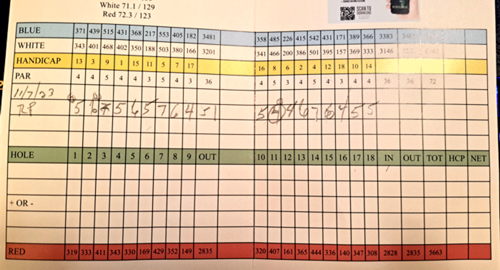
For each of the 18 holes, which the scorecard breaks down into two 9 hole segments, we see a row for blue, which are the most back tees, a row for white, the middle tees, and red for women and senior golfers. The idea is for everyone to take the same number of shots for a par taking into account the distance each group can shot. The little numbers are the distance to the green. Note some courses use different color markers for the tees. Longer courses may have 5 tees from women's to supper golfer. I've been on course where I needed a golf cart to go from the back to the front tees. Don't forget the back tees go first and the women's/senior tees go last.
Handicap is not as straight forward as you would think. If a hole has a handicap of 7, everyone with a handicap over 7 will get one stroke free. A golfer with a handicap below 7 gets no bonus on this hole. Same thing on all the other holes. Of course, if you are not keeping score all this means nothing. Don't worry about it, this is just for informational purposes. Don't even think about the gambling terminology competitive golfers use.
Each hole has a par. A par three means it should take three strokes for a par: The tee shot and two puts. Obviously the hole are short. A par four should take a tee shot, a fairway shot, and two puts. A par 5 takes a tee shot, two fairway shots, and two puts.
Out is a term for the first nine holes, Home or "in" are the second nine holes.
If you take a stroke less than par for the hole it is named a "birdie". If you take 2 shots less than par it is called an "eagle".
On the bad side, each stroke over par is called a bogie. So taking two strokes more than par is a double bogie. Three shots is a triple bogie, and so forth.
The number of shots is the number entered into the little boxes. Sometimes you will see a number in the upper right in a circle and that is the number of puts. if you score a birdie you may put a circle around the number
Penalties are strokes. If you need to replace a lost ball, the rules say an extra stroke. Other penalties are an extra stroke and you have to hit the ball from the original place, and is noted as loss of stroke and loss of distance. If you hit a ball in the water, you lose a stroke. This means the replacement ball you hit from the tee is your third shot. Some holes have special "drop area" if you hit in the water.
Clothing
Golf courses, by definition, leave you exposed to the sun. And unless you are playing very early or very late in the day, even with an overcast sky, you will be exposed to the sun.
And, furthermore, you won't know you've had too much sun until later.
Spring and fall are best served with layers to take off or put on.
Food
Always assume a lack of water on the course. Bring two water bottles with you. You can fill up at the bathroom facilities if necessay. Always ask about on-course water.
Golf Balls and Other Equipment
ijk
Arriving on Time
lmn
sdo sdf;kl s;fdlk
How long does a round take?
♦ Public courses a round goes from 3.5 to 4.5 hours during the week. Weekends expect a slower play when people, without any knowledge of golf, come out of the woodwork.
♦ If you want a smoother round you will need to drive at least 50-75 miles from an urban center. And even there, weekends are can be slow.
♦ In general, plan for whole day to be occupied from getting ready, driving, and finally arriving at the course early enough enough to be ready for tee time.
♦ If you haven't done any stretching before arriving at the source, leave time to do so. It's not a bad idea to stretch again at the course.
♦ After the round you will be tired and hungry, not to mention trying to ignore the ride home. In other words, the whole day is shot.
♦ Check the Time Details to make sure you keep up with your foursome. The greatest sin while playing is being too slow!
Time Details
Waiting on the tee
Depending on the course but mostly you will have only about 12 minutes to t-off. So be ready. Have all your golf balls, tees, gloves, etc. ready before your foursome heads for the first Tee. Introductions take place and you try and remember their names if you are matched up by the starter.
Looking for a lost ball
If you are playing for leisure after a minute or two it is time to put down another ball. If you are scoring I don't what rules you play by for a lost ball. Pros are allowed up to 5 minutes looking for a ball. Some days you may not lose a single golf ball. Other days a dozen seem barely enough. Make sure you have enough to not hold up play.
If you fall behind
For the first few times you may fall behind your group. So pick up your golf ball, carry it to the green, and give a gentle toss towards the hole.
Who goes first
Expert golfers may t-off from the back tees, an average golfer might hit from the middle tees, and women and seniors will hit from the front tees.
Although most people play "ready-golf" some serious golfers toss a tee in the air with everyone standing around and who the tee points to is first. Most likely who plays first is not important. If you are ready you can be first for all it is worth.
Putting
Hanging around the green doing the putting ritual, you will be in close quarters meaning you should know what is going on.
♦ The ball furthest from the hole, in any direction, and even if the ball is off the green (and that includes way, way off the green), plays first. That's why you might pick up your ball and carry it to the green.
♦ You should have a ball marker to mark where your ball lies, so you can replace your ball when it is your turn to putt. Many gloves have a snap to use as the marker. Quarters work great. Dimes are hard to see, pennies even worse.
Water
Always ask if drinkable water is available on the course. Covid took away much of on-course drinking water. Be prepared with at least a couple bottles of water when the cold or Covid protocol prevent you from being hydrated while playing. Be very serious with having enough water!
Keeping score
No need to keep score. Just say you don't want to keep score if anyone asks. You don't need to drive yourself crazy. Use the scorecard for the yardage.
Betting
You shouldn't and you will hate the slow pace of play if gamblers are in front of you.
A good drink and food


©GoodLookingGolf.com 2024